A complete guide covering MVP development, agile methodology, tech stack selection, and how to choose the right development partner for your startup.
Software development for startups is not the same as software development for established companies. Startups operate under tight budgets, short runways, and pressure to prove their idea before the money runs out.
The tools, processes, and team structures that work for a 500-person corporation simply do not fit a team of five trying to get their first product in front of real users. Every decision needs to be faster, leaner, and more deliberate.
This guide covers the full picture: why startups need a dedicated approach to building software, how to plan and ship an MVP, what technology your startup actually needs, and how to find a development partner that moves at your pace.
Key Takeaways
- Build an MVP first. It saves time, money, and reduces product risk at the earliest stage.
- Outsourcing to a dedicated startup development team is often faster and more cost-effective than hiring in-house.
- Your tech stack choice affects your speed, scalability, and hiring ability. Choose wisely.
- Agile development in short sprints helps you ship working software every two weeks, not every six months.
The right development partner brings product thinking, not just coding skills.
Table of Contents
1. Why Startups Need a Dedicated Software Development Company
2. MVP Software Development for Startups
3. How to Choose the Right Tech Stack for Your Startup
4. What Software Does Your Startup Actually Need?
5. How Octet Solutions Works with Startups 6. Frequently Asked Questions
1. Why Startups Need a Dedicated Software Development Company
There is a particular kind of pressure that comes with building a startup. Investor timelines, customer expectations, and market windows all move fast. A large enterprise agency built for corporate clients simply cannot keep up with that pace.
A software development company that specialises in working with early-stage teams operates completely differently. They make decisions quickly, work with incomplete requirements, and help founders prioritise what actually matters at each stage of growth.
This is the foundation of good startup software development: a team aligned with your stage, your constraints, and your goals.
In-House Team vs. Outsourced Development
Both options have a place. Here is how to decide which fits your current stage:
| Factor | In-House Team | Outsourced Partner |
| Cost | High (salaries, benefits, space) | Lower, flexible engagement |
| Speed to start | Slow (hiring takes months) | Fast (team ready in days) |
| Scalability | Limited by hiring pipeline | Scale up or down easily |
| Best for | Post-funding, validated product | Pre-seed to Series A stage |
How a Development Partner Reduces Startup Risk
Startup risk goes beyond bugs and broken features. The biggest risks are strategic: building the wrong product, choosing a technology that does not scale, or running out of runway before you find product-market fit.
A good tech startup development partner brings experience from dozens of products across different industries. They have seen where founders waste money. They push back on bad ideas, recommend simpler solutions, and keep your roadmap focused on validation rather than over-engineering.
What to Look for in a Startup Development Partner
When evaluating development partners, look for these qualities:
- Experience building products at the pre-seed and seed stage
- Clear communication process and sprint-based delivery
- Ability to advise on product decisions, not just execute tickets
- Transparent pricing without long minimum commitments
- References from other early-stage founders
2. MVP Software Development for Startups
Before you build the full product, build the right product. That means starting with a minimum viable product (MVP): the leanest version of your idea that still delivers real value and generates real learning.
What Is an MVP and Why You Should Build One First
An MVP is not a half-finished product. It is a focused product with a specific user problem at its core. It has only the features needed to test whether people will actually use what you have built.
The purpose of MVP software development services is to help you reach that learning moment as fast and cheaply as possible. Once you know your idea works, you can invest more confidently in the full product.
Think of it this way: building a full product before validating demand is like printing 10,000 copies of a book before anyone has read chapter one.
Core Principles of MVP Development
- Solve one problem really well rather than many problems poorly.
- Get the product in front of real users as early as possible.
- Measure user behaviour, not just opinions.
- Use feedback to decide what to build next.
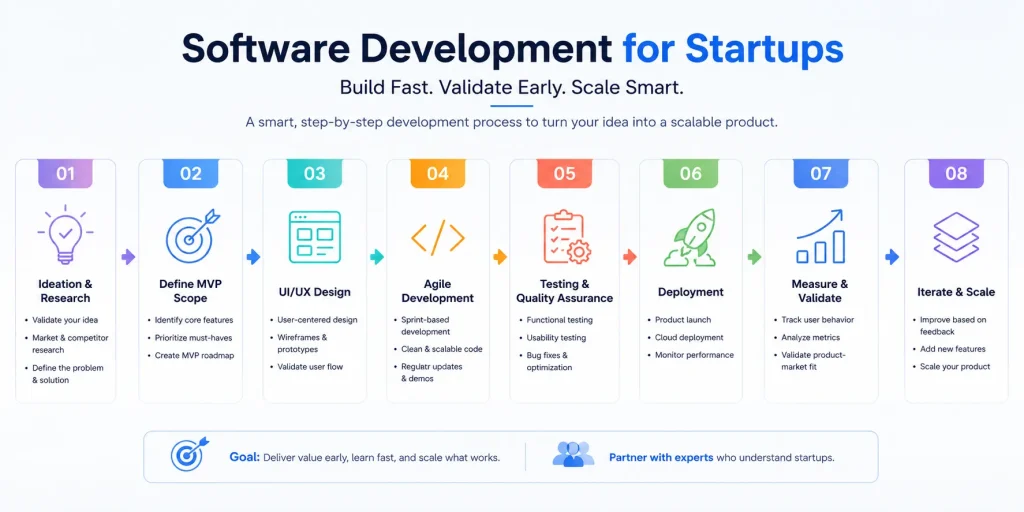
How to Build an MVP in 8 Weeks with Agile Development
A focused MVP is achievable in 8 weeks with agile methodology and a well-scoped feature set. Here is how the process typically works:
| Phase | Timeline | Activities |
| Discovery | Week 1-2 | Define user journeys, choose tech stack, finalise feature scope. |
| Development | Week 3-6 | Two-week sprint cycles. Working features delivered and reviewed each sprint. |
| Testing | Week 7 | QA testing, bug fixes, performance checks, usability review. |
| Launch | Week 8 | Product goes live. Handoff documentation and user feedback collection begins. |
Software development for new businesses that follows this agile sprint model consistently outperforms waterfall approaches. There are no long planning phases, no big reveals at the end, and no surprise delays.
3. How to Choose the Right Tech Stack for Your Startup
Your technology choices shape how fast you can build, how easily you can hire, and how well your product scales. Getting this right at the start saves months of painful refactoring later.
Common Tech Stacks Used in Startup Development
Here is a comparison of technology options commonly used in early-stage product development:
| Category | Options | Best Used For |
| Frontend | React, Vue, Next.js | Web apps, dashboards, SaaS products |
| Backend | Node.js, Python, Ruby on Rails | APIs, business logic, integrations |
| Mobile | React Native, Flutter | Cross-platform iOS and Android apps |
| Database | PostgreSQL, MongoDB, Firebase | Data storage and retrieval |
| Cloud | AWS, Google Cloud, Vercel | Hosting, scaling, deployment pipelines |
Key Factors When Selecting a Tech Stack
When choosing your technology foundation, consider these factors carefully:
- Hiring availability: choose technologies with a large developer talent pool.
- Speed of development: some frameworks allow faster prototyping than others.
- Scalability: ensure the stack can handle growth without a full rewrite.
- Third-party integrations: payment gateways, analytics, and CRM tools need to connect cleanly.
- Community and long-term support: avoid niche technologies with small communities.
4. What Software Does Your Startup Actually Need?
One of the most common mistakes founders make is building too much too soon. Getting clear on what your startup actually needs at each stage prevents wasted development time and budget.
Should I Build a Mobile App or a Web App First?
The right answer depends on where your target users spend their time and how they will interact with your core product feature.
Build a web app first if:
- Your users are primarily on desktop (B2B tools, admin panels, dashboards)
- You need fast iteration without app store approval delays
- Your product involves complex data entry or multi-step workflows
Build a mobile app first if:
- Your product is used on the go (delivery, fitness, location-based services)
- Push notifications are central to your engagement model
- Your target audience is primarily mobile-first consumers
SaaS Product vs. Custom Internal Tool
Startups typically build one of two things: a SaaS product sold to customers, or a custom internal tool that improves their own operations.
If you are building a SaaS product, architect for multi-tenancy, user role management, and subscription billing from day one. These are far harder to add after launch than to build in from the start.
If you are building an internal tool, start rough. Validate that the workflow it supports actually sticks with your team before investing in polish.
A trusted startup app development company will help you answer this question before writing a single line of code. The clarity you gain in that conversation is worth more than any feature.
5. How Octet Solutions Works with Startups
Octet Solutions was built for early-stage founders. Not large enterprises with 18-month roadmaps. We work with startup teams that need to move fast, spend wisely, and ship products that actually work.
Our Startup Development Process
Every engagement follows a structured process designed for startup speed and clarity:
- Discovery call: We learn your business model, target user, and what you need to validate.
- Scope definition: We lock in the MVP feature set and agree on a delivery timeline.
- Sprint-based development: You see working software every two weeks, not just status updates.
- Review and iteration: Each sprint ends with a review where you give direct feedback.
- Launch and handoff: Full documentation, deployment support, and post-launch guidance.
Startup-Friendly Pricing and Engagement Models
Most agencies are built for corporate clients. Their pricing, contracts, and team structures do not fit early-stage realities.
At Octet, we offer three engagement models designed specifically for startup budgets and timelines:
| Model | Best For | How It Works |
| Fixed Scope | Defined MVP or feature build | Agreed scope, timeline, and price upfront. |
| Sprint-Based | Ongoing product development | Monthly sprints with flexible priorities. |
| Hybrid | Growing startups post-launch | Core team retainer plus sprint capacity. |
Our Startup Success Stories
The founders who move fastest are the ones who make early decisions with clarity: about scope, about technology, and about what they are actually trying to prove.
We have taken teams from a rough idea to a live, funded product in under three months. We have rebuilt fragile internal tools into scalable platforms. We have guided first-time, non-technical founders through their entire first product launch, keeping them informed and in control at every step.
If you are not sure where to start, or things have already gotten complicated, that is exactly where we do our best work.
| Ready to Start Building? The best time to get your software development right is before you have made expensive mistakes. The second-best time is right now. octetsolutions.io |
Frequently Asked Questions
What is software development for startups?
Software development for startups is the process of designing, building, and launching digital products (web apps, mobile apps, SaaS platforms) specifically tailored to the budget constraints, speed requirements, and validation needs of early-stage companies. It differs from enterprise development in its emphasis on lean scope, rapid iteration, and learning from real users quickly.
How much does it cost to build a startup app?
A focused MVP typically costs between $8,000 and $30,000 depending on scope and complexity. A full SaaS product with advanced features, integrations, and multi-user support can go higher. Starting lean and expanding based on validated demand is always more cost-effective than building everything upfront.
How long does MVP development take?
With an experienced agile team and well-defined scope, most MVPs can be shipped in 6 to 10 weeks. The most common cause of delays is changing requirements mid-build. The clearer your scope at the start, the more predictable your delivery timeline.
Should I outsource software development or hire in-house?
For most pre-seed and seed-stage startups, outsourcing to a dedicated startup app development company is the faster and more cost-effective option. You get a full team immediately without the cost or time of hiring. Once your product is validated and revenue is consistent, building an in-house team becomes more practical.
What tech stack should my startup use?
The right tech stack depends on your product type, your growth targets, and the developer talent pool you plan to hire from. For most web and SaaS products, React or Next.js on the frontend with Node.js or Python on the backend works well. For mobile, React Native or Flutter covers both iOS and Android from a single codebase. A good development partner will recommend a stack based on your specific situation, not just current trends.